Paintings
Life’s Bias
Available
$1,500.00
- Plate
- No. 61
- Type
- Original, one of a kind
Original artwork, as listed. Photographed in daylight and left unretouched. Hand-made surfaces vary, so small marks and texture are part of the work, not flaws. Ask for a condition note or extra photographs at any time.
We pack each work by hand in Accra and ship it insured, with tracking. Most orders leave within five working days, and large paintings travel crated. Delivery is free and fully insured.
Every work comes with a certificate of authenticity naming the title, size, year and artist. If it is not what you expected, tell us within 14 days of delivery and send it back in its original packing.
Questions about this work? Email the studio
The work
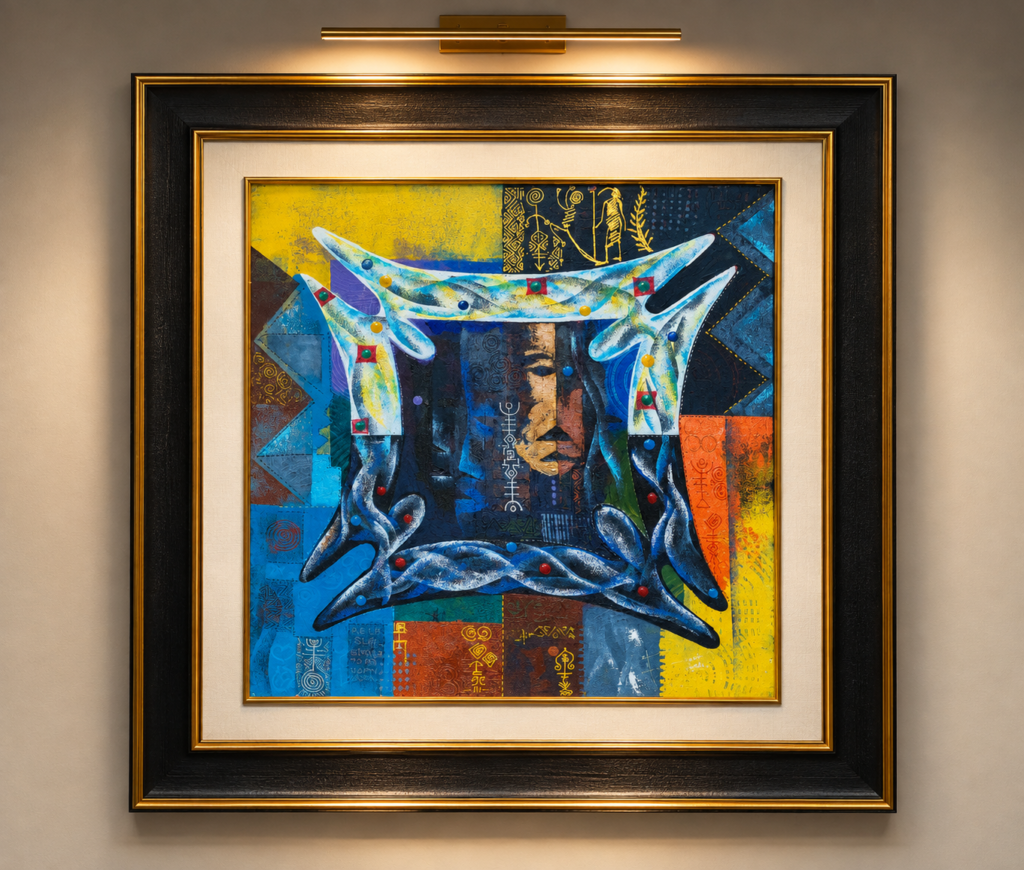
Life's Bias
An interpretation by Ashiteye:
Life rarely presents itself to us in its true colours. We see it through the colours we have inherited, the experiences we have endured, the people we have loved, and the fears we have learned to carry. What appears obvious to one person may be invisible to another. What one calls opportunity, another may recognise as danger. And what we believe to be truth may sometimes be no more than a perspective we have never had reason to question.
Life’s Bias is a meditation on this quiet, persistent force that shapes the way we see the world.
At first glance, the painting draws us into a vivid collision of blues, yellows, reds, and greens. The colours are bold, almost competing for our attention, yet none exists in isolation. They overlap, interrupt one another, and form unexpected relationships. There is beauty in the disorder, but also a deeper question: are we seeing the whole picture, or only the parts that speak to us?
The blues suggest reflection, memory, and the depth of the unknown. The fiery reds and oranges evoke passion, conflict, urgency, and the intensity of human experience. Yellow brings the promise of optimism, but its brightness can also expose what we would rather leave in shadow. Green offers renewal and possibility, reminding us that even in a complicated world, growth remains within reach.
Yet these colours do not carry a single meaning. Their significance changes according to where we stand, what we have experienced, and what we are prepared to believe. The same shade that comforts one person may unsettle another. This is the nature of bias: it quietly influences not only what we notice, but also what we make of it.
Scattered throughout the composition are symbols, patterns, and forms that resist a single, immediate interpretation. They invite us to look again. Perhaps they represent the beliefs passed down through generations, the cultural lenses through which we understand our place in the world, or the fragments of identity that we assemble into a sense of self. Perhaps they are simply reminders that meaning is not always given to us; sometimes, it is something we bring.
At the centre, a dark, rounded form rests among the surrounding movement. It may be read as a gathering point, a quiet centre of gravity, or a reminder of the self beneath the noise. Around it, the composition continues to shift and expand. Life moves, people influence us, circumstances change, and our convictions are tested. We may believe ourselves to be impartial, yet we are continually shaped by the worlds we inhabit.
The painting also speaks to the human tendency to divide what is fundamentally connected. We distinguish between right and wrong, familiar and foreign, success and failure, us and them. These distinctions can help us make sense of life, but they can also narrow our understanding of it. We begin to favour the colours that affirm our beliefs and distrust those that challenge them. Gradually, our perspective becomes our boundary.
And yet, along the lower edge, the repeated dark silhouettes suggest a shared human presence. Individual figures appear distinct, but they belong to the same visual landscape. Each carries a different story, a different history, a different way of seeing. None possesses the entire picture, and none stands entirely outside it.
Perhaps this is the most important truth within Life’s Bias: we are all participants in the world we interpret. Our judgments affect other people, just as their judgments affect us. Our assumptions can create distance, but awareness can open a door. Understanding does not require us to abandon our convictions; it asks us to recognise that our convictions may not tell the whole story.
The work does not ask us to become colourless, neutral, or free of perspective. That may be impossible. Instead, it invites a more honest kind of seeing: the willingness to question our first impressions, to listen before deciding, and to make room for truths that do not resemble our own.
After all, life is not a single colour, a single story, or a single point of view. It is an intricate composition of experiences, contradictions, hopes, and histories, constantly altered by the eyes through which it is seen.
Perhaps wisdom begins when we stop asking why the world refuses to look the way we see it, and start asking what our own eyes might be missing.
Life’s Bias reminds us that the picture is always larger than our perspective—and that the courage to see beyond ourselves may be one of the most beautiful forms of human growth.